Budget Assumptions That Will Kill Your First Kennel Acquisition

The assumptions that kill kennel acquisitions aren't made in the kennel. They're made before you open the doors. Here's what to fix before you build your projection.

TL;DR

  • Daycare included in overnight boarding means your napkin model overstates revenue by 40% on every boarding dog.
  • Flat annual occupancy hides the dead months that create real cash flow stress — lenders want month-by-month Year 1 projections.
  • The previous owner's clients were loyal to a person, not a building. Plan for 60–70% of historical occupancy in Year 1.
  • If you live on the property, a full salary draw signals double extraction to any lender who understands this business model.
  • Working capital must be modelled separately from the purchase price. If you can't identify that number, you're not ready to acquire.

It's happened to all of us.

The neighbour's dog barking in the distance wakes you up. Come on, it's 2 a.m., and you need to get up early. It takes a moment to place it because you're groggy and disoriented. It's the neighbour's dog, right?

It isn't. He's yours, and he's been out in the dark for hours.

The feeling that follows isn't just about the dog. It's the compound weight of being completely certain about something that turned out to be entirely wrong: embarrassment, responsibility, and more than a little guilt. You had assumed someone else let him in. It seemed so logical at the time.

Assumptions can be dangerous, especially when animals are involved. But the assumptions that can really cost you aren't always the ones you make in the kennel. Sometimes they're the ones you make before you open the doors.

When I purchased my kennel, I made an assumption that took a while to find. When I found it, that same feeling hit. First embarrassment and then guilt. I should have known better.

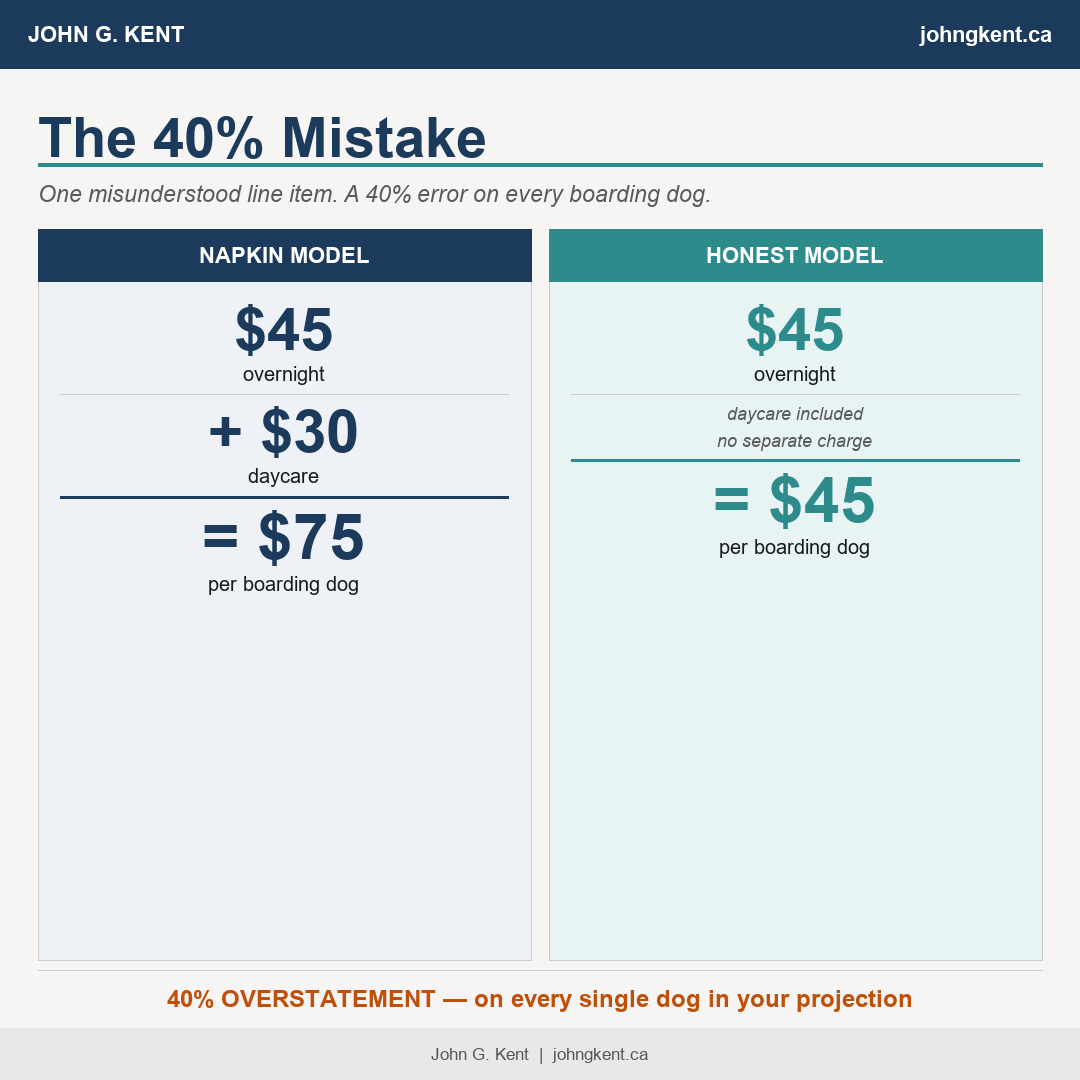
I assumed daycare was billed separately from the overnight rate. It seemed logical. A dog stays overnight and participates in daycare during the day — of course, that's two billable services. The rates today are $45 for overnight and $30 for daycare. The napkin model charges $75 per boarding dog. The honest model puts $45. That's a 40% overstatement on every single dog in the projection, and at the time, our numbers weren't far off. The rates have changed since we bought the kennel, but the math works the same way. I caught it before it cost me the purchase, but what I wasn't prepared for was the feeling that came with finding it. The same embarrassment from two in the morning. The same stomach drop when I realised and then asked myself, "What else did I wrongly assume?"

Finding it wasn't relief. It was heartburn. That immediate, stomach-churning moment of oh my god, what did I just do. Because it isn't just about the approval anymore, it's the questions that stem from the failure. Was the kennel viable? Should I even be approved? And once that door opens, you go down the rabbit hole — double, triple, quadruple checking every number on the page. Are these real? What other mistakes could I have made?

Can we actually afford this? Because this isn't a business plan anymore. This is the rest of our lives.

There are many assumptions people make when they're looking to purchase a kennel. Here are some of the most expensive ones you should steer clear of.
The Revenue Model Assumption

The first place most projections go wrong is revenue, and it usually isn't because the buyer was careless or dishonest. When your projections are overly simplified, a small mistake can compound quickly.

The daycare pricing mistake described above is one example. A 40% revenue overstatement from one misunderstood line item. But it isn't the only place the revenue model breaks down.

Model Overnight Rate Daycare Rate Total per Boarding Dog
Napkin Model $45 +$30 (billed separately) $75
Honest Model $45 Included $45
The napkin model overstates revenue by 40% on every boarding dog. At scale, this distorts every line of your projection.
The 40% Mistake — kennel acquisition revenue model comparison infographic
Napkin model vs honest model — a 40% overstatement on every single boarding dog.

When we opened, we put real time and money into a treat display. A proper setup with liver treats, dispensers, chew toys, and Kongs. They were the kind of indestructible products I'd buy for my own dogs. I even got a wholesale account to source good products at a decent margin. It made sense on paper. Dogs love treats and owners love spoiling them, so why wouldn't they buy from us while they were here?

They didn't. Not because the products weren't good. Because most owners had already packed their dog's treats before they left home. The ones who hadn't mostly didn't care. The display sat there looking great and generating almost nothing.

The food assumption was bigger. The only kennel experience I had suggested that the kennel supplied the food, so I modelled it that way. I assumed 40–50% of dogs would need food from us — it seemed reasonable at the time, though I couldn't point to hard data to back it up. At 50% occupancy with 20 rooms, that's roughly seven dogs a day needing food. At $5 a day per dog, the revenue looked tidy. What I hadn't accounted for was cost. At $75 per bag and 50 cups per bag, the food costs $1.50 per cup. A dog eating two cups a day costs you $3.00. Your margin per dog per day is $2.00, not $5.00.

When you abruptly switch a dog's food, however, things get messy. Literally, and no amount of revenue justifies what happens in that suite when a dog who didn't bring their own food gets whatever you have on hand. We eventually moved to a policy where clients bring their own food, and the operational headache disappeared completely.

Between the treat display and the food revenue, we had modelled roughly $7,000 in profit that did not materialise. That's not to say yours wouldn't. But banking on it is a dangerous assumption.

The Occupancy Assumption

The problem with a flat occupancy percentage is that it looks responsible. Seventy percent for the year. Clean, simple, and easy to run debt service calculations against. What it doesn't show you is that people don't travel on a spreadsheet.

People don't travel evenly throughout the year. They travel in patterns driven by their lives. Young families with school-age children travel in July and August when kids are out of school. Business travellers go year-round. Families with athletes book around hockey tournaments in winter and baseball in summer. Your occupancy follows their calendar, not a smooth curve. According to the QuickBooks State of Small Business Cash Flow Report, 64% of small businesses report that seasonal revenue fluctuations create predictable, yet unplanned, cash flow gaps. A kennel is one of the clearest examples of why.

At our kennel, January drops sharply after the Christmas dogs go home. February is quiet. March break creates a spike. April and May are flat, with long-weekend bumps. June is mediocre. Then July hits, and it goes gangbusters — July and August are easily twice as busy as any other month. September settles. October has a Canadian Thanksgiving bump. November is dead. Early December is dead. Late December is at a hundred percent capacity, or in our case, more than capacity, because we keep trying to squeeze in one more.

That's where the story comes in. We book a dog into a room immediately after one checks out. One Christmas Eve, a client didn't show up for check-out. When we finally connected late that evening, she could barely speak because she was drunk.

He ended up in the grooming room, the only space we had. He got loose sometime in the night and ran the hallway until every other dog in the place was awake and wound up. We helped because we felt bad for the owner. But one extra dog in a pinch costs us a full night of disrupted animals, and that's a cost that doesn't show up anywhere in a projection.

And here's the part that catches most buyers off guard. Canadian lenders — BDC, the big six banks, and the Canada Small Business Financing Program — all require Year 1 projections broken down monthly, with Years 2 and 3 quarterly, and a debt service coverage ratio of 1.25 or higher. That's a minimum of 2 to 3 years of projections, with each month in year 1 individually defensible. Most buyers don't realise that until they're sitting down to build it, and by then they've already committed to the flat number as their baseline. Doing occupancy honestly — month by month, multi-year, driven by actual customer demographics and travel patterns — is more work than most people are prepared for.

The Client List Assumption

When you buy an existing kennel, the previous owner's customer list appears to be a valuable asset. It's part of what you're paying for, so most buyers assume your occupancy will remain at historical levels. Why wouldn't you? The customers are already captured, booked, and loyal to the facility. Unfortunately, they aren't.

Here's what that assumption misses. When someone on social media asks for a kennel recommendation, they don't say, "Go to this kennel because they have excellent facilities and professional staff." They say go to this kennel because John and his people are awesome. More often than not, when people recommend a kennel, they're recommending a person, not the business. When that person changes, the recommendation stops working. The customer list you inherited isn't a transferred asset. It's a historical record.

Even under stable ownership, businesses typically lose 10% to 25% of their customer base every year. When ownership changes, that baseline gets worse. The trust that kept those customers loyal was personal, and it doesn't transfer with the sale.

When we took over, we didn't have access to the previous owner's formal customer list. We had her Google Business Page to capture her incoming requests, but her actual contact list didn't transfer to us for 5 months. When we finally got it, we discovered what we'd already sensed from the bookings we'd had — her list was stagnant. Dogs had passed away, and families had moved on. It wasn't a curated customer base. It was a database with inactive entries.

The honest projection starts lower than the previous owner's occupancy. Based on our experience, plan for 60–70% of historical occupancy in Year 1, and expect the rebuild to take 18–24 months. That estimate is based on one acquisition, not industry data, but it's a more defensible starting point than assuming nothing changes. Not because the business isn't good, but because those customers came to her, not to a building. You have to earn them yourself, and that takes time.

The Salary and Household Assumption

When a lender evaluates a kennel acquisition, they're not just looking at whether the business can service its debt. They're looking at the entire household's debt, known as the global debt service coverage ratio (GDSCR). They calculate your personal and business debt obligations separately and then combine them. Can your household, as a unit, service all of that debt simultaneously?

Before you structure anything around this, speak to an accountant. Do it before you build your projection, not after.

Here's what most buyers don't understand about their salary: if you live on the property, the business is already covering your mortgage. It should also cover a portion of your utilities, phone, and property taxes. When you then model a $60,000 salary draw on top of that, you're pulling more out of the business than it looks like on paper. The lender who understands this business model reads that salary line and asks how much the property itself is already covering. That's bleeding the company dry.

Most lenders look for a debt service coverage ratio of at least 1.25, meaning the business generates $1.25 in cash flow for every dollar of debt obligation. The standard applies across BDC, the Big Six banks, and the Canada Small Business Financing Program. A common misconception is that 1.0 is enough because it covers the payments. That doesn't leave any room for the unexpected — and in a kennel, especially one that is new to you, the unexpected isn't theoretical.

Only last year, when we were looking to build our new house, we were trying to increase our debt load. Our strategy was to pay off an old car loan to free up the cashflow going out to the payments and roll the remaining balance into the new mortgage, adding only about ten thousand dollars to the total. The math worked. We could find the headroom in our debt service ratio.

Then Veronica left for a midnight shift and hit a deer around the corner. Even though the car was only four years old, they didn't opt for repair. In an instant, the deal was scuttled because a new car would add $40,000 to the mortgage, rather than $10,000. We had to build the house from cashflow and increase the income for the kennel before we could proceed with the refinance. Sometimes the right move is accepting a worse short-term position to protect the deal you actually want. We had the benefit of time. Not everyone does.

The bank's calculation is rigid. They're not asking whether you can make the payments. They're asking whether your ratio meets their threshold. And twenty-five dollars a month can be the difference between approval and rejection.

The Working Capital Assumption

Buyers assume that occupancy will remain at historical levels, so cash flow should cover operations on day one.

You likely won't have consistent occupancy for the first few months, however. Suppliers want payment on terms you haven't earned yet. Staff need to be paid whether or not you have dogs in the rooms. Utilities and debt service don't pause while you're ramping up. That gap between what you need to pay bills and when booking revenue actually covers them is working capital. And it needs to be modelled separately from the purchase price.

The numbers on this are sobering. Research by Jessie Hagen, formerly with U.S. Bank and cited by SCORE, found that 82% of small business failures are linked to poor cash flow management rather than underlying profitability problems. According to Guidant Financial, 33% of small business owners identify cash flow as their single biggest ongoing challenge. Statistics Canada data puts the first-year failure rate for Canadian small businesses at 21.5%. Most of those businesses weren't unprofitable. They just ran out of runway before revenue caught up to expenses.

When we bought the kennel, it took five months for the business revenue to cover monthly operating costs. Thankfully, I had consulting income to bridge the gap. Most buyers discover in month two that they need emergency credit they didn't plan for, and start pulling personal savings they thought were protected.

The honest projection accounts for this. It models the monthly burn rate during ramp-up and identifies the gap that personal resources or external credit must cover. If you can't identify that number, you're not ready to make the acquisition.

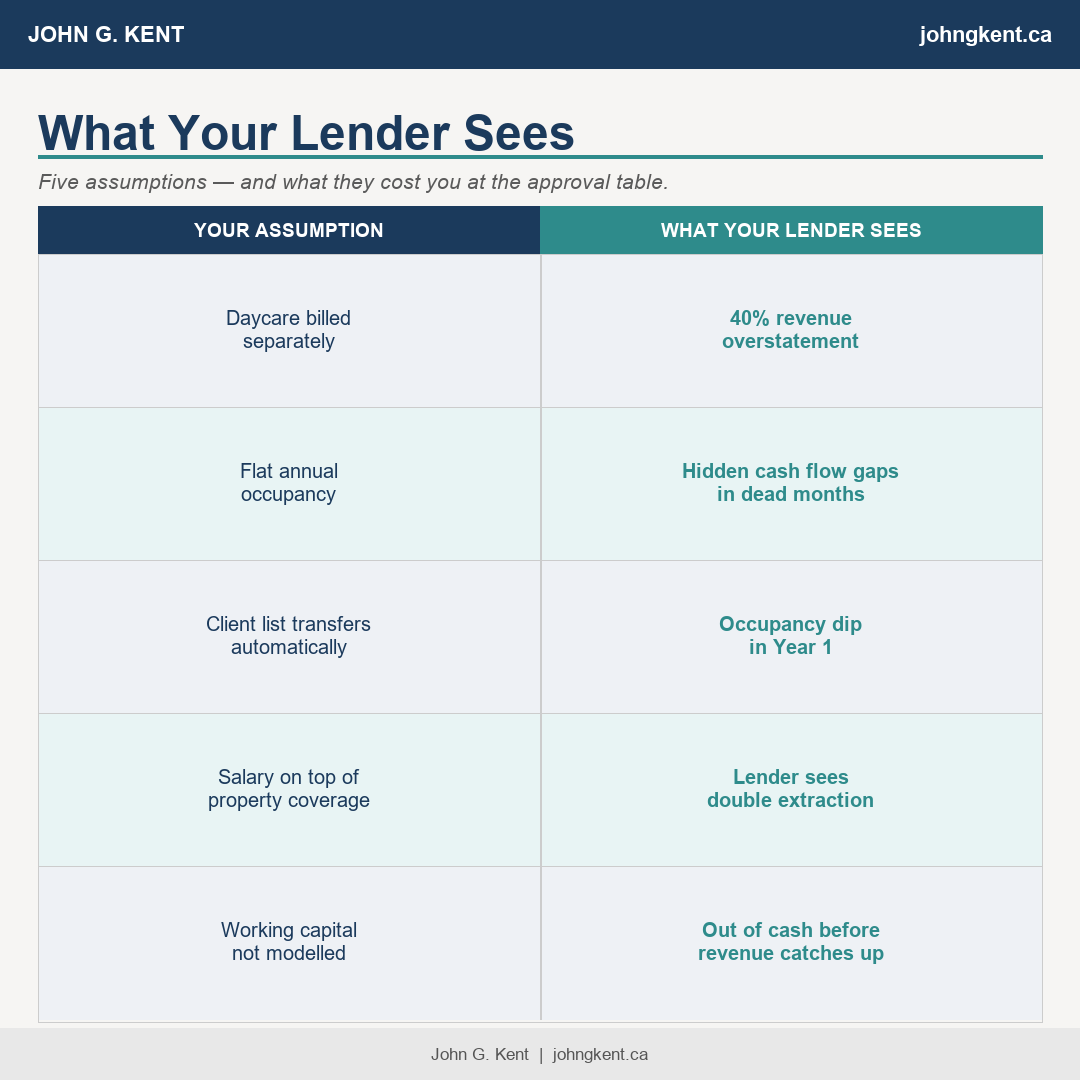
What Your Lender Sees — five budget assumptions and their consequences infographic
Five assumptions — and what each one signals to a lender at the approval table.

The Flashlight

You're probably looking at this list by now and feeling overwhelmed and unsettled. That's actually the right feeling. It means you're taking it seriously.

Complexity doesn't mean complicated. It means detailed. And the details are manageable if you break them into pieces.

The model we built — monthly projections with occupancy broken down by income type, staffing thresholds that trigger based on occupancy levels — sounds like a lot. But it's just a series of small questions asked month by month. What's our occupancy in January? What does that mean for payroll? What does that mean for supply costs? What's the cash flow that month?

Start with the previous owner's actual numbers. Put them in a spreadsheet. Break them down month by month. Watch what happens when you change one assumption. The spreadsheet shows you immediately what that costs you. That's something a napkin budget never could.

And when the lender pushes back on your assumptions, you have the answer because you've already stress-tested it. You're defending a robust model.

We've built a starting budget for new owners to help you do exactly that. Understanding the full cost picture before you build your projection is the first step. We’ve built an interactive version of this model. Use the Kennel Startup Budget Calculator — adjust your numbers month by month and get a lender-ready summary you can print.

The dark isn't going anywhere. But now you have a flashlight.

Ready to go deeper? The JGK Finance Hub walks through how lenders evaluate every dimension of your application.

Frequently Asked Questions

What are the most common budget assumptions that sink kennel acquisitions?

The most expensive assumptions are built into the revenue model. If you assume daycare is billed separately from overnight boarding, you overstate revenue by up to 40% on every boarding dog. Flat annual occupancy projections mask the dead months that create real cash flow stress. And most buyers never model working capital as a separate line — which means they run out of runway before revenue catches up to operating costs.

How much working capital should I have before buying a kennel?

A reasonable starting point is 3 to 6 months of operating expenses, modelled separately from the purchase price. The exact figure depends on your ramp-up timeline and occupancy trajectory. When we bought the kennel, it took five months for revenue to cover monthly operating costs. Model the monthly burn during ramp-up, identify the gap, and confirm you have a source to cover it before you close.

What debt service coverage ratio do Canadian lenders require for a kennel purchase?

Canadian lenders — including BDC, the Big Six banks, and the Canada Small Business Financing Program — typically require a minimum DSCR of 1.25, meaning the business must generate $1.25 in cash flow for every dollar of debt obligation. Year 1 projections must be broken down monthly and individually defensible. A ratio of 1.0 is not sufficient — it leaves no room for the unexpected, and in a kennel acquisition, the unexpected is not theoretical.

Will an existing kennel's client list transfer to me when I buy it?

The list transfers, but the loyalty does not. Customers who recommended the previous owner were recommending a person, not a building. When ownership changes, that personal trust doesn't carry over. Based on our experience, plan for 60–70% of historical occupancy in Year 1 and expect the rebuild to take 18–24 months.

Should I take a salary from the kennel if I live on the property?

Speak to an accountant before you structure anything around compensation. If you live on the property, the business is already covering your mortgage and a portion of your utilities and property taxes. Modelling a full salary draw on top of that signals a double-extraction problem to any lender who understands the kennel model.

Is it worth buying a kennel if I have to rebuild the client base from scratch?

It depends on the price you paid and the strength of the facility. A client base that needs rebuilding is a negotiating point, not a deal-breaker — if it's reflected in the purchase price. Build the occupancy dip into your Year 1 projection, price the deal accordingly, and confirm you have the working capital to survive the rebuild period.

John Kent

About the Author

John Kent

Owner-Operator, Loyalist Barkway Boarding Kennels · Founder, JGK Academy

John Kent is the owner-operator of Loyalist Barkway Boarding Kennels in Bath, Ontario, and the founder of JGK Academy.

author avatar
John Kent
Scroll to Top