Walk into the wrong kennel, and you hear it before you see anything.
It is not just barking. More like a wall of sound. A physical pressure that hits you in the chest before your eyes have adjusted. Staff moving through the space wear hearing protection. Dogs at the back are barking at dogs at the front, who are barking at nothing in particular, except that the dog beside them started it. You are watching a noise machine sustain itself.
If you are touring facilities before you build or buy, pay attention to that moment. Not because it tells you the operators are bad people. In many cases, they are doing the best they can. But it tells you something permanent about the building itself.
That Noise Has a Number
Active dogs in a kennel can produce sound levels regularly exceeding 100 decibels, with peaks as high as 125 dB. For context, OSHA requires hearing protection for workers exposed to sustained noise above 85 decibels over eight hours. At 100 decibels, that recommended exposure time drops to 15 minutes.
That is the staff experience. Now consider the dogs.
Dogs hear at frequencies far more sensitive than humans. A 2012 study published in the American Journal of Veterinary Research used Brainstem Auditory Evoked Response testing — the same clinical method used to diagnose hearing loss — on dogs housed in kennels for six months. More than half showed a reduction in hearing sensitivity of 20 decibels or greater. In humans, even a 10-decibel shift is considered clinically significant. Those dogs arrived healthy. The environment changed them.
Research has also shown that cortisol levels in kennel environments can run up to three times higher than those measured at home, with noise identified as one contributing factor. This is not really controversial anymore. The physiology is well understood and the research is peer-reviewed.
We still hear this occasionally at Barkway, and it catches people off guard every time. A client walks through the building, looks around, and says: I did not realise you actually had dogs in here. That quiet is not accidental. It comes from the building design itself. Each dog has its own room. Sound does not travel from one dog to twenty nearly as easily. The walls absorb part of the problem before staff ever have to manage it.
Some operators try to solve the noise issue with acoustic panels, and to be fair, they do help with echo and reverberation. A treated room can feel noticeably quieter than an untreated one. But the underlying issue remains. If the room begins at an extreme noise level, better does not necessarily mean safe. You can spend significant money reducing the symptoms of a design problem without ever fully solving the design itself.
And noise is only one part of the equation.
The Cage-Free Argument Is Built on a False Choice
Before going further, something needs to be said plainly.
The cage-free boarding movement marketed itself as the humane alternative to keeping dogs in crates for long hours. The imagery works because nobody wants to picture a dog confined to a small wire crate for most of the day.
But over time, the industry started treating cage-free and open concept as though they were automatically the same thing. They are not.
A private suite is not a crate. It is a room. The dog can stand, turn, stretch, move freely, settle into its own bed, and exist in a space that smells familiar and does not require social negotiation with other dogs. That distinction matters more than people realise.
The exercise conversation follows a similar pattern. Open concept facilities frequently position themselves as offering continuous activity and cardiovascular benefit that enclosed suite facilities supposedly cannot provide. But that misunderstands what healthy exercise actually looks like for most dogs.
Most trainers will tell owners that dogs should arrive exercised before boarding or daycare. That part is the owner's responsibility, not the building's design feature. At Barkway, dogs go outside multiple times a day in structured yard rotations. Sniff work in a properly managed outdoor environment is often more mentally exhausting than an hour of chaotic group play. It works on a different part of the nervous system. It settles dogs rather than continuously elevating them.
Quiet one-on-one interaction with a staff member who actually knows that dog also becomes very difficult when one person is managing a large open room of animals at the same time.
A lot of what gets called exercise in large group environments is really just continuous stimulation. Those are not the same thing. A dog can come home physically tired while still being mentally overloaded.
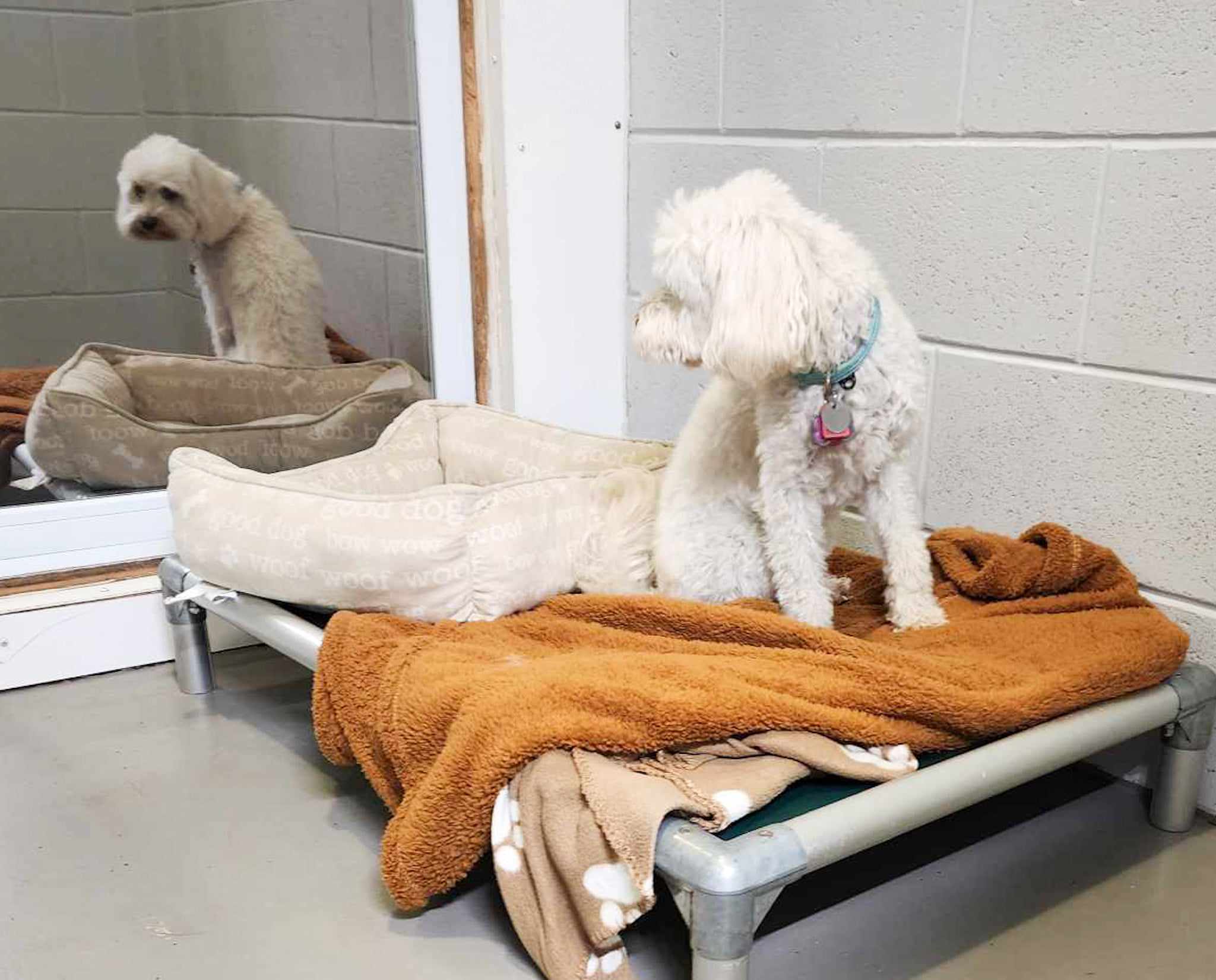
Every Dog Needs a Space That Is Theirs
This is not a preference issue. It is biology.
Adult dogs generally require 12 to 14 hours of sleep per day. Senior dogs often need more. Puppies can require 18 to 20 hours, spread across repeated naps, because that is when muscle development, nervous system maturation, and behavioural learning consolidate.
But rest is only part of the picture.
Dogs also need time to decompress after social interaction. Not necessarily sleep. Just the ability to exist without another dog constantly demanding engagement, eye contact, movement, or response.
Just as you cannot nap when someone keeps poking you in the face, a dog cannot fully decompress when another dog remains in its direct social space. Turning down the lights in a shared room is not enough. The nervous system stays partially engaged regardless.
For puppies, the consequences are worse. A few minutes of dog-to-dog play at a time, followed by substantial quiet time, is healthier than continuous stimulation throughout the day. Not because puppies dislike play, but because overtired puppies start making poor social decisions. They misread cues. They become reactive. Some lose the ability to settle even when finally placed somewhere quiet, because they have spent the entire day operating in a heightened state.
But this is not just a puppy issue.
The ten-year-old lab needs decompression too. The anxious rescue who spent the morning holding it together needs it even more. The young retriever who appears endlessly social often needs more rest than the owner realises.
Breeders understand this better than many facilities do. Responsible breeders advise new owners to avoid high-stimulation boarding environments during the early developmental months. They are not being overly protective. They are applying the same developmental principles they already use at home. And every owner who follows that advice is, by default, not booking with an open concept facility.
So ask the design question directly. Your building is full. You have a five-month-old puppy in the facility. That puppy needs significant rest, needs decompression after short periods of stimulation, and cannot spend the entire day socially navigating fifteen other dogs.
Where does that puppy go?
If the answer is nowhere, the design decision was already made long before the puppy arrived.
The Dog Your Screening Did Not Know About
Temperament testing is standard practice and a reasonable starting point. The problem is what it cannot predict.
A short meet and greet in a controlled setting screens for known behaviour patterns. It cannot reliably screen for unknown triggers.
An owner may genuinely believe their rescue German shepherd is completely safe around other dogs because that has been their experience. What they may never have encountered is the moment when that dog locks onto a small white fluffy dog across a room and something instinctual activates.
The prey drive was always there. Nobody had reason to see it before.
In a suite-based facility, those two dogs may never visually engage with each other. In an open concept environment, that trigger exists continuously throughout the stay, separated only by a barrier that may not hold a determined dog.
This is where the debate around temperament testing often misses the larger point. The screening itself is not necessarily failing. The design is being asked to absorb risk that nobody knew existed. Screening reduces known risk. Enclosed design contains unknown risk. Those are two very different forms of protection.
It does not take overt aggression to create problems. One startled yelp from a dog can ripple across a room almost instantly. Group arousal spreads quickly in shared environments. It only takes one before everyone else responds. In a suite-based facility, the reaction often stops at the wall.
Veterinary trauma literature consistently identifies dog-on-dog bite wounds as a significant portion of emergency cases globally. The industry's own trade press acknowledges that extended periods in large group environments produce overtired, less tolerant dogs over time. The data exists.
Then there is the legal reality. A landmark Ontario Court of Appeal ruling issued May 4, 2026 confirmed that anyone in possession of a dog, including a kennel operator, is considered its owner under the Dog Owners' Liability Act for the duration of that care. Liability is not restricted to the legal owner. It extends to whoever is best placed to control the animal and prevent harm. That is you, for every dog in your building, for every hour they are in your care.
The connection between facility design and incident risk simply does not get discussed enough.

The Costs You Are Not Modelling
The economic argument for open concept usually starts with construction cost and capacity. More dogs, fewer walls, lower initial build expense. On paper the spreadsheet often looks attractive.
But the spreadsheet does not fully capture the downstream costs.
Acoustic treatment becomes an additional expense layered onto a building that was never designed for quiet. And staff turnover in high-noise, high-stress environments is real. Come for the puppy kisses, stay for the migraines.
Then you have incident costs, veterinary bills, refunds, reputation management, and the long-term exhaustion that comes from operating inside constant overstimulation.
Then there is the revenue your facility quietly excludes before you ever open the doors.
At Barkway, seven of the twenty-seven suites are designated for dogs that require additional privacy. Depending on the season and how proactively we screen, between ten and thirty percent of our boarding population benefits from individual space. Some of those clients came to us specifically because other facilities could not safely accommodate their dogs.
Open concept facilities do not turn difficult dogs away because they want to. They turn them away because the building left no workable alternative. The muzzle, the timeout that returns the dog directly to the same stressors, the conversation with an owner explaining why their dog was injured. These are not management decisions. They are design consequences.
Free Resource
Designing your facility and want a checklist to work from? The Facility Design Checklist walks through the decisions that matter before you build.
Get the Facility Design ChecklistPrivacy Is Not Punishment
The operators who muzzle the dog, remove the dog, or push the dog back into the same environment are usually not bad people. Most are trying to manage the options their building left them with while paying their mortgage. That matters. Every operational decision eventually traces back to the floor plan.
There is a financial case for private space running through every section of this article. There is a welfare case alongside it. But there is one more reality aspiring operators need to hear honestly.
Every operator takes bookings early on that, in hindsight, they probably should not have. The mortgage does not care about your principles in month three. Anyone who has carried a building understands that pressure.
But that is exactly why the building itself matters so much.
You will compromise somewhere in the early years regardless. The one place you cannot easily compromise is the facility design, because it becomes the hardest thing to reverse later. You can tighten your screening process next year. You can become more selective once revenue stabilizes. You can fire difficult clients when you are ready.
You cannot unbuild an open concept facility without effectively starting over.
Do not become the kennel that accepts every booking and tries to solve structural problems with a muzzle and willful blindness. The stressors do not disappear because everyone stopped talking about them. The overstimulation is still there. The incompatible dogs are still sharing space. The puppy is still redlining.
Build the infrastructure that gives you options later.
The operator who builds private space from the beginning can choose to become more selective over time.
The operator who builds open concept may eventually discover the building already made that decision for them.
