What I Didn’t Expect From Dogs
I'll admit it. I've been accused once or twice of having too much fencing. And to be fair, my views on fencing have evolved. We've had a few learning experiences along the way.
I come from a farm background. When you build cattle fencing, it has to be solid. If it's not, they'll walk right through it. There's no negotiation there. What I didn't fully appreciate at first is that dogs are different. Not easier. More capable.
They can jump higher than you expect. They can climb. They can dig. And when they're given both the opportunity and a reason to be on the other side of the fence, they will try. Dogs have a way of looking at the other side of a fence as greener, whether there's anything there or not.
Thankfully, none of our learning experiences resulted in injury or long-term consequences. But that's not always the case. Some kennels have lost dogs. Kennels where dogs have been injured because the fencing wasn't adequate, or because a small oversight turned into a real problem. And those are mistakes you can't take back.
The Setup We Didn’t Question
It wasn't a fencing problem at first. It was movement.
And to be fair, this wasn't something we built from scratch. When we took over the kennel, the yard was already there. Roughly 60 by 60 feet, with 5–6 foot chain link fencing. It had been used that way for a long time. It wasn't perfect, but it worked well enough to get by.
Like many new operators stepping into an existing setup, we accepted it as is. Not because it was ideal. Because we didn't yet know what to question. That's a common position to be in. You don't know what good looks like yet, so you assume what's there must be close enough.
On paper, we had space. In practice, we had a problem. The yard wasn't connected to the kennel. To get the dogs into it, we had to walk them about 50 feet from the building. Around an orchard. Up and down a hill. One or two dogs at a time. So that's what we did.
Until it didn't work.
The Dog Was Gone
We had a dog slip a collar. And not just slip a collar and get caught a few minutes later.
The dog was gone.
For two days.
Eventually, it came back, and we were able to capture it. But those two days felt a lot longer than that. It was right when we had opened. We felt terrible. We lost sleep over it. The owners had mentioned the dog was a bit jittery. But that's not enough. That's not something you can lean on after the fact and say, "Well, that explains it."
It was our system. And our system failed.
In those moments, the feeling isn't just stress. It's something heavier. It's the realisation that everything you've put into this, whether it's a hundred thousand, three hundred thousand, or even half a million dollars, can come apart in an instant because of a single failure. A decision. A missed detail. A system that wasn't as strong as you thought it was. You start to wonder if you're done before you've even really begun. That's the part people don't talk about.
We learned a lot from that, about fencing, about handling, about making sure collars are properly fitted, and about how quickly things can go wrong when you rely on too many things going right at once.
When It Goes Wrong Twice
Around the same time, another employee was injured. She was walking too many dogs at once, bringing them back down the hill toward the kennel. Uneven ground, too much movement, not enough control. They pulled her over, and she got hurt. Those dogs could have been gone just as easily. They weren't. And we were fortunate for that.
But it exposed something else, not just a system issue, but a staffing one. She wasn't the right fit for what we needed. And just as importantly, we weren't giving her the structure or the tools to succeed in that environment.
When your system depends on perfect handling, you're going to have failures. Fencing changes that. Because once it's there, it's consistent. It doesn't get tired. It doesn't make judgment calls. It doesn't try to manage too many dogs at once. It sets the boundary. And within that boundary, it becomes much harder to make the kinds of mistakes that lead to problems in the first place.
What the Dog Is Actually Trying to Reach
Most balanced dogs are content inside a four-foot fence, as long as you're in there with them. You're the focus. The fence is irrelevant. The moment something outside becomes more interesting than you, the calculation changes completely.
Two kinds of dogs test fencing, and they do it for different reasons.
The first is the driven dog. It smells something. Hears something. Catches a movement down the road. Whatever it is, it's out there, and the fence is just an obstacle between the dog and that thing. These dogs problem-solve. They're not distressed. They're motivated. The fence has to be stronger than whatever has their attention.
The second is the anxious dog. It's not chasing something. It's trying to reach something it's already lost: a person, a safe space, the thing that makes the world feel right. These dogs don't just test fencing. They go through it.
My Vizsla, Tango, is anxious by nature and attached by design. He's gone under fences and over them. Once, he even chewed through a solid bedroom door to get to my wife, who was standing just on the other side.
He didn't want outside. He wanted her.
No fence height fixes that. What fixes it is understanding the motivation, and building a system that holds up against it.
It wasn't the fence we got wrong. It was what we assumed about dogs. We went into this thinking we knew what they were capable of. What we didn't account for was how quickly that changes when a dog has both the opportunity and a reason. We underestimated them: how high they could jump, how easily they could climb, how persistent they could be when digging, how destructive they could become when motivated.
And more importantly, we misunderstood what fencing was for. It isn't containment. It's the removal of options.
We upgraded to six-foot fencing, thinking that would solve it. For some dogs, it did. For others, it didn't matter, because height isn't really what a dog is measuring. They're reading whether the top looks reachable. Whether the frame looks like something they can grip, pull over, or commit to. A dog doesn't calculate. It decides.
That's when we stopped thinking about fence height and started thinking about how the fence looks from the dog's perspective. We eventually added a military-style angled extension across the sections that mattered most. The frame angles inward at the top, with smooth white poly wire running through it. Visible from the ground. Designed to be seen. The dog looks up, reads the top of the fence as something that doesn't end where they thought it did, and most of the time, they don't start.
The dog that had already scaled our seven-foot fence hasn't been back since. That was years ago. Nobody has tried that section since we added it. We didn't make the fence taller. We made it look unclimbable. Because that's the only contest that matters: the one happening in the dog's head before it ever leaves the ground.
Dogs don't just jump fences, either. They climb them. They work at them. They test the bottom over time. They pace along them until they build themselves up into a state where they're more likely to act. Tango is very good at finding gaps. He'll dig under a fence if there's space, and you'd swear he could teleport over a five-foot fence. Dogs like that force you to be honest about your setup. Because they don't care what you intended, they only care what's possible.
The instinct when you see all of this is to go higher, stronger, more. And that helps, but only to a point. Because fencing isn't just about stopping movement, it's about shaping behaviour. We started dealing with reactivity along fence lines. Dogs seeing each other, pacing, building up. So we introduced privacy yards: in one case, a fence that blocked visibility on both sides. It worked, but it introduced a new responsibility. You have to watch the ground because posts settle and gaps form. Smaller dogs test places you wouldn't expect. Every solution creates a new variable you didn't have before.
Even if your fencing is solid, your environment isn't. We had a dog scale a fence because someone started a chainsaw nearby. We've had dogs react to diesel engines. One learned to associate the sound of a garbage truck with stress because it was repeatedly triggered by it. That matters. A calm dog and a triggered dog are not the same animal. A dog that would never look twice at your fence on a quiet Tuesday afternoon is a completely different problem when something outside the property gets its attention. Your system has to hold up under both situations.
And then there's the layer you hope you never need. Dogs we identify as flight risks are fitted with GPS trackers. Not because we expect them to get out. But if they do, time matters. That's the difference between hoping and knowing. It doesn't replace fencing. It doesn't replace handling. It's a backstop, one more layer. Because when you've lived through losing a dog, even temporarily, you stop thinking in terms of "that probably won't happen" and start thinking in terms of what happens if it does.
How Much Space Is Enough
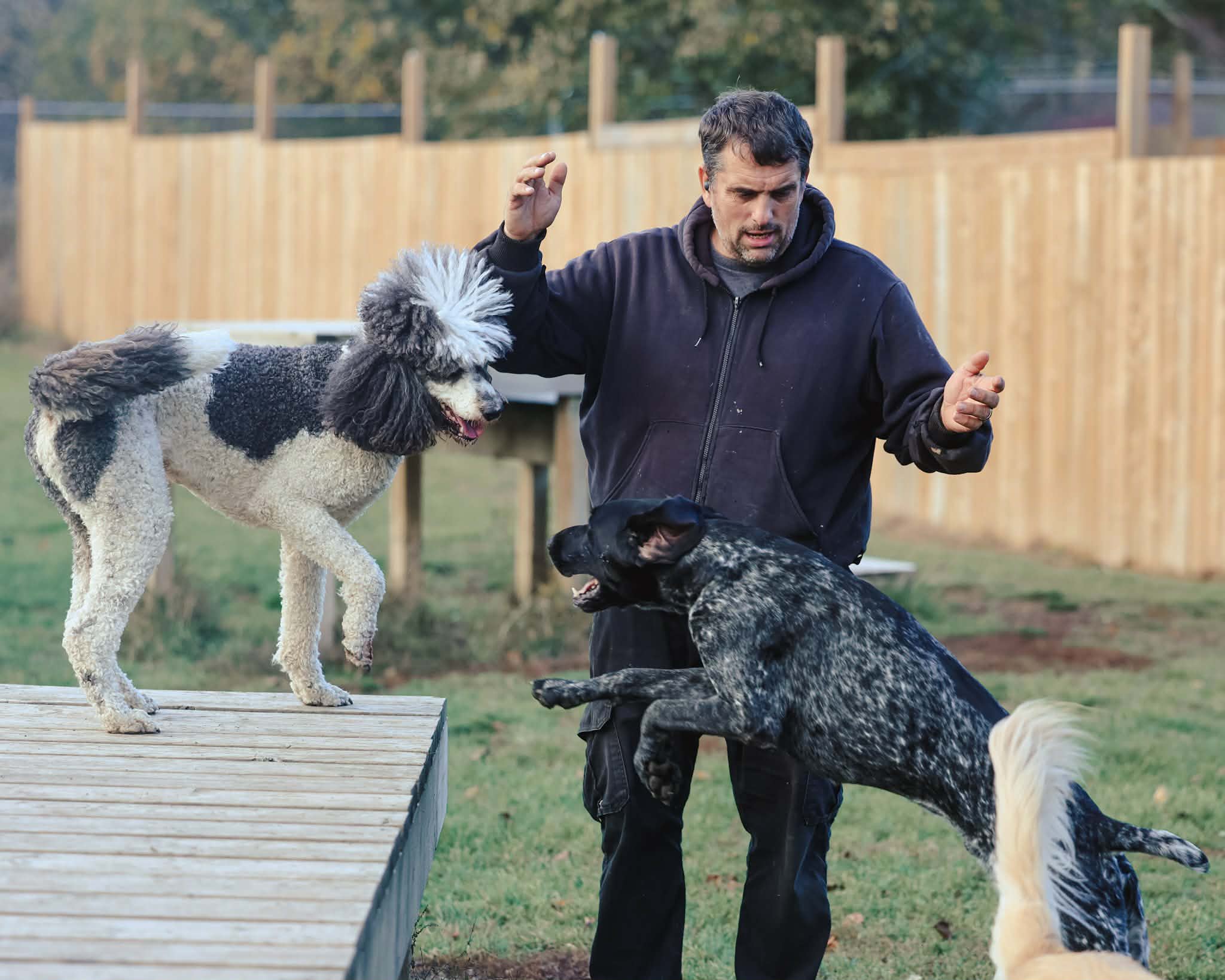
Some operators go large: acres and acres, and that comes with its own set of problems. Recall breaks down at a distance. Dogs that don't want to come in have more room to play the game, and in a group, that energy spreads fast. Monitoring large numbers across a large space becomes genuinely difficult. And the economics of fencing that much perimeter push operators toward shorter heights. Less clearing means treelines full of wildlife right at the boundary, which is exactly the kind of thing that sends a driven dog straight at the fence.
We aimed to create a space large enough for dogs to run without hitting the fence, but small enough that we can see what's happening, respond quickly, and actually gain their attention when recall matters. That's not a compromise. That's a design decision.
When you take over an existing operation, the fencing that's there has probably been there for a decade. The previous owner maintained it. Kept it standing. Made it work. And over time, stopped seeing it. Not out of carelessness, just because nothing had failed recently enough to make them look. If it isn't broken, there's no obvious reason to spend money on it. So it becomes part of the background. The fence, doing its job, exactly as it always has.
What you inherit isn't just the fence. You inherit the blind spot. The question isn't whether it's standing. It's whether it was ever built for the dogs you're running now, in the volume you're running them, with the environmental triggers your property has. Most new operators don't know how to ask that yet. And by the time they do, something has usually already gone wrong.
Where Things Actually Break
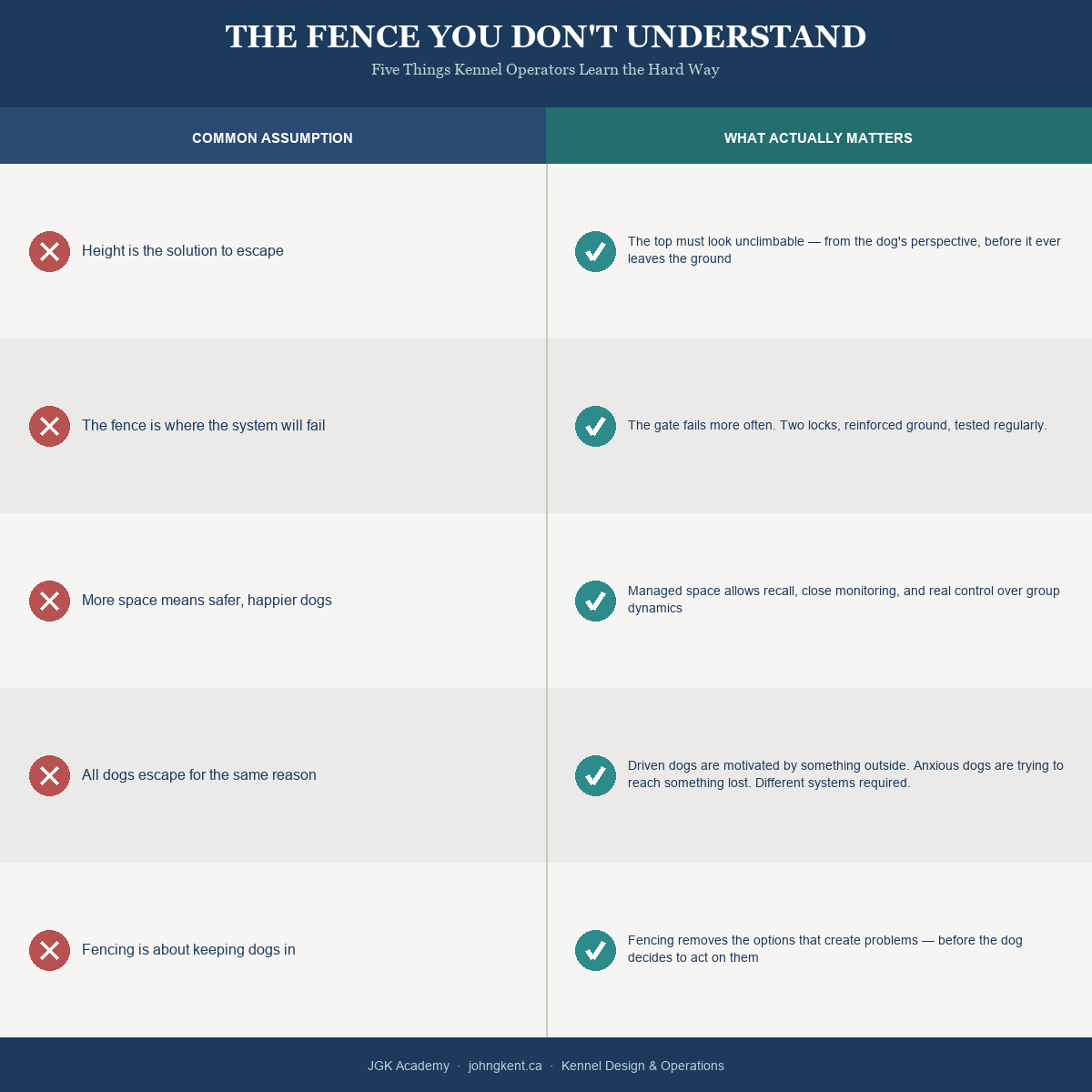
It's rarely the fence that fails anyway. It's the gate. That's where most systems break. A dog jumps. A latch shifts. A gate opens. Now we use two locks wherever possible. Reinforce the ground. Test them regularly. Because if a dog can interact with it, it will.
Fencing isn't just something we've built. It's integral to how everything runs. Dogs move directly into enclosed spaces. High-risk areas have layers. Some sections are double-fenced. Gates are controlled. The system doesn't hope everything goes right.
Fencing evolves. It should. What you want to avoid is going backwards: redoing work because you didn't think far enough ahead. There's a difference between refining something and fixing something under pressure.
Fencing isn't about keeping dogs in.
It's about removing the options that create problems.
If you think like a person, you'll build a fence.
If you think like a dog, you'll build something that actually works.
