
I have a small secret I rarely share with clients.
Loyalist Barkway isn’t exactly close to Kingston. It’s a bit of a drive — a beautiful one, as it turns out, along Lake Ontario. By the time most clients arrive, they’ve forgotten about the distance. But, practically speaking, most of our clients are already heading west anyway, toward the airport or beyond. We’re a stop on a route they were already taking.
The drive doesn’t cost them anything extra. It’s already factored in.
Unfortunately, that math doesn’t work the same way for employees.
The Variable the Pro Forma Doesn’t Model
When operators model a kennel acquisition or an expansion, they model revenue per suite. They model loan payments, occupancy rates, and seasonal variance. Some model build cost per square foot.
Only a few model the labour pool they can actually access at their specific location.
That’s the number that determines whether the scaling decision works. Capital costs are spread over years. Salaries are paid immediately and don’t pause in January.
Ontario’s minimum wage is $17.60, and according to the Ontario Living Wage Network, Eastern Ontario’s living wage sits at $21.65 per hour for 2025. With that in mind, we post kennel attendant positions at $22 per hour at the Barkway. We deliberately set the starting rate above the living wage to attract people with real experience or valuable education.
And still, we can’t reliably fill the role.
The reason isn’t the wage, but something more complicated. It’s the net pay calculation. A student driving from Kingston to Bath fills a 45-litre tank roughly once a week at current Kingston pump prices of $1.63 per litre. That’s just over $73 per fill, or roughly $300 per month in fuel. A 12-hour part-time week at $22 per hour grosses $264 before tax. The gas bill doesn’t leave much of the paycheque.
A coffee shop in Kingston doesn’t have that problem. Neither does a grocery store on Princess Street. The commute math never enters the equation for those employers.
We’ve adapted. Long weekend shifts, up to ten hours, mean two days of work produce meaningful income without four commutes. Two weekend shifts get someone to 20 hours, which changes the calculation enough to make it viable for the right person.
But that flexibility only works at our current size. The moment daily coverage becomes a requirement, seven days a week, the flexible shift model breaks down. You’re back to the commute problem every single day.
The Hidden Cost of Churn
Here’s what makes the rural staffing problem expensive beyond the wage line.
According to a review of nearly 3,000 kennel employee resumes, 42% of kennel workers stay with their employer for less than one year. The average kennel employee is between 20 and 30 years old. These are your students. They want the work; they’re genuinely good at it when they find the right fit; then they graduate and go home to Thunder Bay or back to Toronto, or they do the gas math and quietly stop booking shifts.
Replacing them costs between 10% and 30% of a replacement worker’s annual wage, according to industry estimates, and for a part-time rural position, that’s real money. Multiply it across two or three churn cycles in a single year, and it becomes a staffing cost that appears nowhere in your pro forma.
But the wage replacement cost is only part of it. When you can’t fully trust a new hire with a reactive dog, you’re the insurance policy on every shift they work. The hours you spend shadowing someone you’re not yet confident in are hours you’re not spending on the operation. For rural operators drawing from a part-time student pool, the gap between who applied and who you can actually leave alone with a difficult dog is often wider than expected.
The Layers
This is where scaling gets complicated, and where most operators discover the problem too late.
The staffing constraint isn’t one variable. It’s several, and they compound.
Geography determines who’ll drive to you and under what conditions. A rural facility draws from a smaller pool than an urban one. Higher wages help, but don’t solve a net pay problem driven by fuel costs — the industry as a whole faces persistent labour shortages. For rural operators, that shortage adds a layer that urban operators don’t have to deal with.
The facility model determines your dogs-per-person ratio at scale. A suite-based facility where dogs regulate themselves in private spaces, as we have at the Barkway, operates differently from an open concept environment where one person manages a shared room of 20 or 25 animals. At a small scale, both can work. As dog numbers increase, the ratio problem in an open concept facility compounds faster than headcount can address it. One person can’t safely intervene in a fight in a room with 25 dogs. The math on that isn’t complicated. It’s just uncomfortable.
Increment size determines how many cost plateaus you cross at once. The cost structure of a kennel expansion doesn’t move in a straight line. It moves in steps, and the steps aren’t evenly spaced.
At the Barkway, we added two rooms first by converting storage space. No new thresholds crossed, absorbed into existing operations without meaningful disruption. Then seven more by converting the original kennel building — still working within existing infrastructure, the roofline, the electrical, and the drainage already in place. A fundamentally different calculation than new construction.
Admittedly, there were days we wondered whether it would’ve been easier to bulldoze the original kennel and start clean. That’s the hidden cost of conversion that nobody thinks about. You inherit every problem the original structure carried. The workarounds accumulate. At some point, the cost of adapting exceeds the cost of starting over. But we persevered and came up with what we now call the back kennel, a building we’ve dedicated to privacy dogs. Though it did cost, we have found a way to add value in every room by charging more for the privacy it provides.
A few years later, we modelled a ten-room full expansion. It was exciting. We were looking at new concrete, a comparable structure, full electrical, and water that drew off the existing system. Every threshold at once. Who wouldn’t be excited? It was going to be everything we ever wanted all at once.
But it didn’t pencil.
The trip wire in all of this is the building permit. The moment one is required, you’re no longer renovating. You’re building, and the municipality treats it accordingly. Among the costs that appear at that point is fire suppression. Ontario’s Building Code ties suppression requirements to occupancy type and building classification, and the threshold varies by municipality. The number isn’t the same everywhere. But when you cross it, the cost is real, it’s immediate, and it doesn’t appear in a revenue-per-room model. Check with your local building department before you draw a single line on paper.
Operators considering expansion actually face three options, not two. Convert existing space and inherit its limitations. Build new and absorb every threshold at once. Or bulldoze and rebuild clean, which feels wasteful until you price the other two honestly. Having options forces you to think about what you want to achieve.
Seasonal variance means the capacity you add for Christmas and Thanksgiving sits partially empty in January and November. You can’t justify a full-time hire on peak revenue alone, but you can’t reliably staff peak periods with part-timers who’ve moved on to something more consistent.
Each of these layers, in isolation, looks manageable. The problem is when you start stacking several elements simultaneously. A rural suite facility scaling past a permit threshold in a shoulder season is managing geography, churn, capital, and cash flow constraints at once, none of which appear as line items in the expansion model. Can you afford to close for renovations? Your clients aren’t going to reschedule their vacations.
What This Means Before You Commit
Paul Kott, Founder and CEO of Puppazoo, put it plainly in a recent industry discussion: labour costs force large-group environments with minimal oversight in virtually every traditional commercial dog-care model. He’s right. But the rural operator’s version of that problem differs from the urban one, and the open concept operator’s version differs again. The layers aren’t the same across facilities, but every facility has them.
If you’re already stretching to staff your current operation, more rooms don’t fix that. They expose it.
There’s one more variable that doesn’t appear in any pro forma. Some rural operators build informal family capacity into daily operations. My kids are at an age where one can come in and help clear rooms. We’re deliberate about what they handle and what they don’t. Around here, they go by Employee 1 and Employee 2. It works, it’s real, and it can’t be transferred in a sale. A buyer inheriting this business can’t inherit that.
Before You Scale, Look at What You Already Have
The most overlooked expansion strategy doesn’t require a building permit.
Before you model a ten-room addition, ask what your current footprint is actually producing.
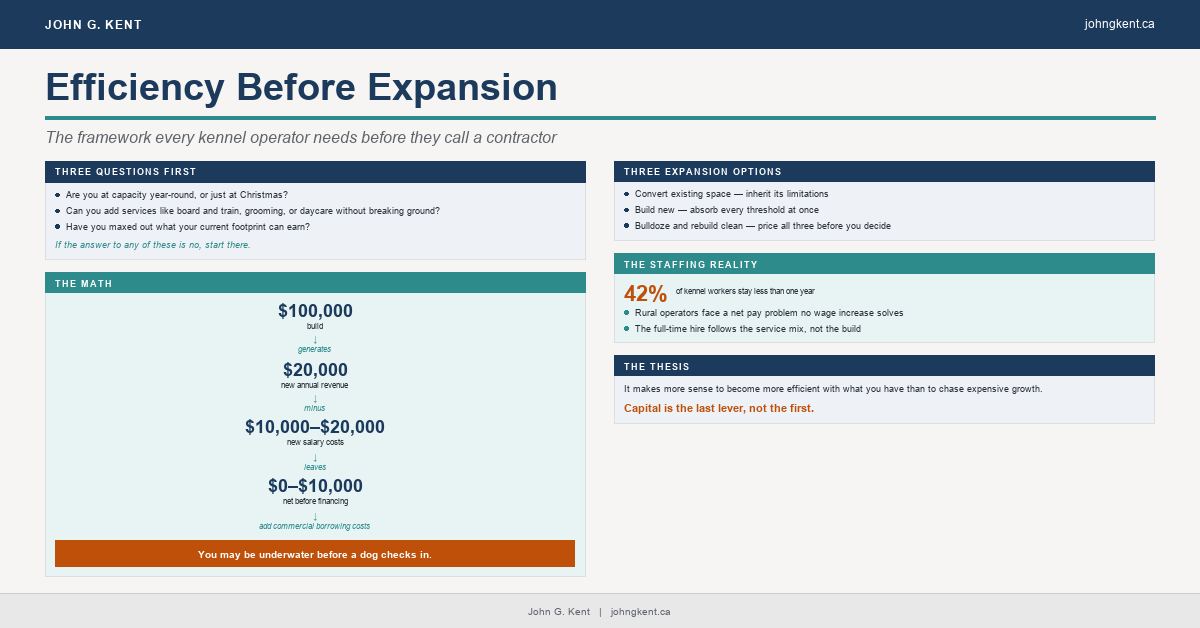
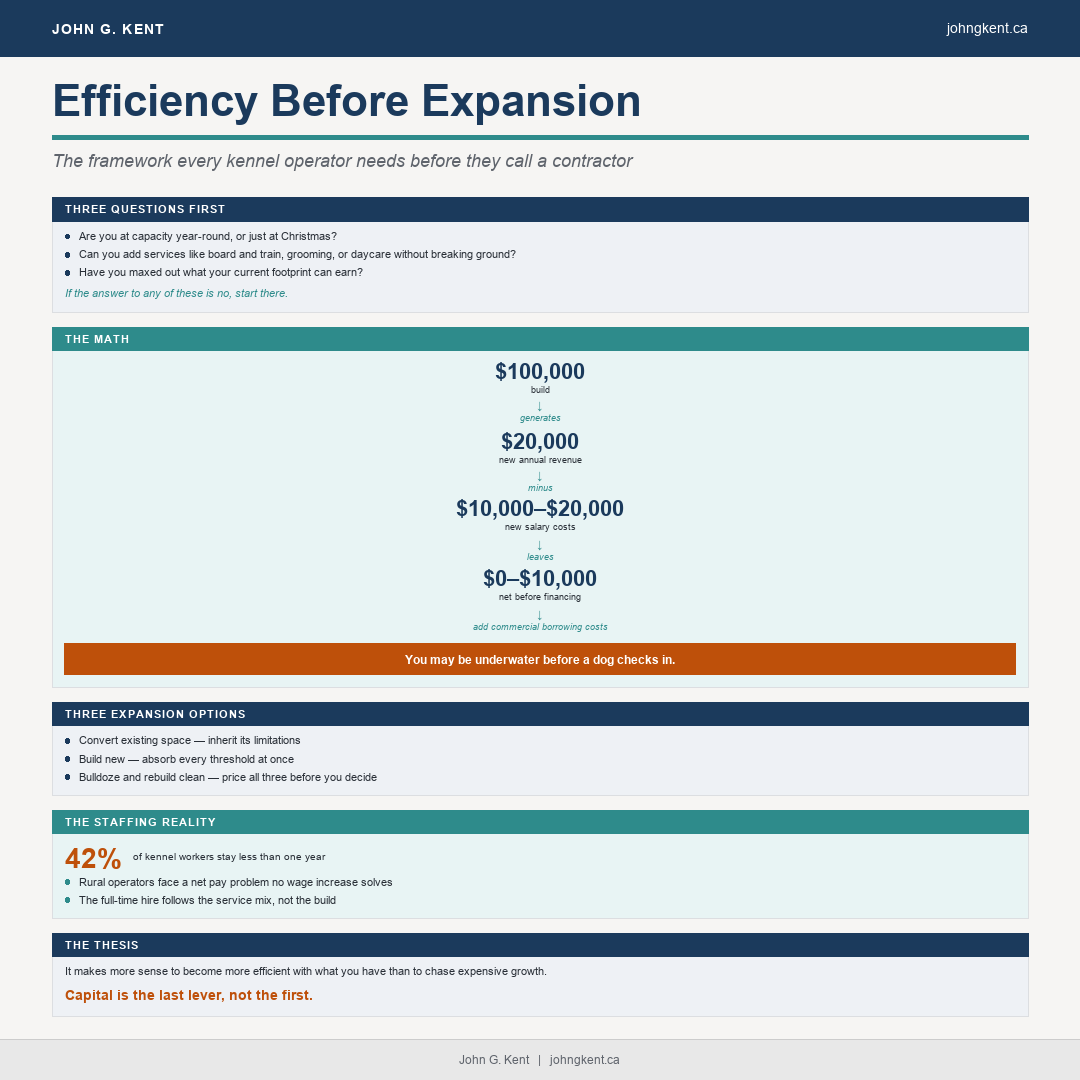
Are you at capacity year-round, or just at Christmas? Can you add services like board and train, grooming, or daycare without breaking ground? Have you maxed out what your current footprint can earn?
If the answer to any of those is no, start there.
Then run the actual investment math. A $100,000 build might generate $20,000 in additional annual revenue. But that same expansion could trigger $10,000 to $20,000 in new salary costs to staff it. Before financing, you’re looking at somewhere between zero and $10,000 in net return on a $100,000 outlay. Add commercial borrowing costs and you may be underwater before a dog checks in.
The only scenario where the numbers recover is a full refinance spread over 25 to 30 years, which drops the annual debt service to something manageable but means you’re paying for today’s expansion with tomorrow’s equity, against equipment and infrastructure that won’t last 25 years. The depreciation and amortization curves don’t match, and the gap between them is where operators get into real trouble.
The expansion that looked like growth on paper turned out to be an expensive break-even when we ran the real numbers. That’s what stopped us.
It makes more sense to become more efficient with what you have than to chase expensive growth. Capital is the last lever, not the first.
Frequently Asked Questions
How much does it cost to expand a dog kennel?
A $100,000 build might add only $20,000 in additional annual revenue, while staffing it can cost $10,000 to $20,000 a year. Before financing, your net return often sits somewhere between zero and $10,000. The numbers usually only recover over a full refinance spread across 25 to 30 years.
Should I expand my kennel or add services instead?
Start by asking whether you are at capacity year-round or only at Christmas, and whether you can add board and train, grooming, or daycare without breaking ground. If your current footprint is not maxed out, becoming more efficient beats new construction. Capital is the last lever, not the first.
Why is it so hard to staff a rural kennel?
A rural facility draws from a smaller labour pool, and fuel costs quietly erode net pay. A student commuting to a $22 an hour shift can spend roughly $300 a month on gas, which changes the calculation even above a living wage. Higher wages help, but they do not solve a net pay problem driven by distance.
How much does kennel staff turnover actually cost?
About 42% of kennel workers stay less than one year, and replacing one costs between 10% and 30% of their annual wage. Across two or three churn cycles in a single year, that becomes a real cost that appears nowhere in a pro forma. The hours you spend shadowing an unproven hire are a hidden cost on top of the wage.
When does a kennel expansion need a building permit?
The moment a permit is required, you are no longer renovating, you are building, and the municipality treats it that way. That triggers costs like fire suppression, which vary by occupancy type and municipality. Check with your local building department before you draw a single line on paper.
Before you scale, the design decision has to be right. If you haven’t read this yet, start there. Privacy Is Not Punishment
Ready to model your expansion? Run the numbers first. Kennel Startup Budget Calculator
