
Before You Build: The Viability Framework for Kennel Owners
The Difference Between Wanting Something and It Being Viable
Most people don’t fail because they lack passion. They fail because they confuse desire with viability.
We envision perfect guests, happy clients, and nothing going wrong. We imagine businesses that grow in neat, linear arcs. The story is emotionally compelling. It’s also rarely how things unfold.
This is a free framework written for people considering starting, buying, or expanding a boarding kennel or dog daycare facility in Canada and beyond.
Who This Is For — and What This Is Not
This piece is written for people who are about to cross a threshold: moving from in-home boarding or side-project scale into professional kennel ownership, buying an existing kennel, or building one from scratch. It’s also for operators outgrowing a smaller facility and stepping into something larger, more regulated, and more capital-intensive.
This isn’t a step-by-step guide or a checklist. It’s a mapping system. The goal is to surface the terrain — where assumptions tend to break, where systems start to strain, and where viability quietly fails — so you can navigate it with fewer blind spots.
Like most useful maps, this one isn’t meant to answer every question for you. It’s meant to help you ask better ones.
The Transparency Problem
What you see on social media
Most people don’t evaluate business ideas in a vacuum. They evaluate them by watching what appears to work for other people. Today, that observation happens largely through social media, polished websites, and curated entrepreneurial narratives. You see the beautiful facility, the happy clients, the steady stream of bookings. What you don’t see are the months of regulatory delays, the thin margins, the staff churn, or the long stretches where the business is just grinding along without any of the glamour that gets posted online.
The acquisition illusion
When you walk through an existing kennel a handful of times and see ten dogs each visit, it’s easy to form a mental picture of “this place is always busy.” In reality, you’ve seen a few snapshots, not the seasonal lows, the midweek gaps, or the long-term occupancy patterns. Sellers may report annual income figures, but those numbers often mask volatility, uneven demand, and the operational strain required to generate them.
How money actually flows
Cash-heavy operations, informal payments, and “off-book” practices create a fog around true performance. Sometimes this is deliberate. Sometimes it’s just cultural habit. Over time, those habits shape the financial picture outsiders see. The records begin to reflect what was documented, not what actually happened. Even formally prepared financial statements can be misleading — accounting classification choices change how healthy a business appears in the short term.
The inherited distortion
People often don’t realize they’re working with a distorted model of reality because the distortion is inherited. They learned the business from someone else. Psychologists call one version of this the Dunning–Kruger effect: being confidently wrong because you lack the context to see the limits of your own understanding. The result is a persistent transparency gap — viability decisions made on numbers that look tidy but hide volatility, fragility, and operational strain.
Financing Reality
New builds vs. existing operations
New builds are materially harder to finance than existing operations. When you’re buying an existing kennel, a bank can point to historical revenue, observable demand, and cleared zoning hurdles. When you’re building from nothing, everything is uncertain at once: construction risk, permitting risk, ramp risk, and market risk. Even if the long-term economics are sound, the short-term uncertainty stack makes lenders nervous.
The equity hurdle
Commercial loan-to-value ratios are typically much lower than what people are used to on residential mortgages — meaning significantly more cash up front. It’s not unusual to discover you “qualify” for a project in principle, but can’t clear the equity hurdle in practice. Goodwill and auxiliary structures that matter operationally often don’t count much in appraisals, creating a gap between what the business is worth and what a bank will lend against.
The personal finance paradox
When someone moves from being an employee to being an owner, borrowing becomes harder at the same time that personal exposure to business risk increases. Wage income is predictable. Owner income is variable. Partners add another layer — banks underwrite the people, not just the business. A partner can be operationally excellent and still constrain what’s financeable because of their personal credit profile.
Banks aren't villains
The friction isn’t personal; it’s structural and cultural. Words like “growth,” “traction,” or “profitability” carry different meanings depending on whether you’re speaking as a founder or through the lens of a lender. The spreadsheet captures interest. It doesn’t capture Thanksgiving.
The “It’ll Do” Trap
How it starts
A lot of early decisions in small businesses are made under the mindset of “this will do for now.” Residential crates, light-duty kennels, and chain-link panels get used not because they’re the best long-term fit, but because they’re available and affordable in the moment. What quietly changes, often without anyone explicitly noticing, is the time horizon. A hobby becomes a livelihood. A short-term project becomes a 10- or 20-year operation.
What dogs do to infrastructure
Dogs are not gentle on infrastructure. They chew. They scratch. They slam doors. They test every weak point. Residential-grade solutions that look fine on day one degrade quickly in a high-wear environment. What felt like saving money up front turns into a replacement cycle.
The real cost
It’s not just that you buy something twice. Opportunistic, non-standardized capital choices create compounding friction later. You save a little up front because something is available, and you pay a lot later because nothing is replaceable. Viability improves when capital quality matches the durability demands of the business you’re actually committing to — not the business someone tentatively assembled from whatever was cheap and on hand at the beginning.
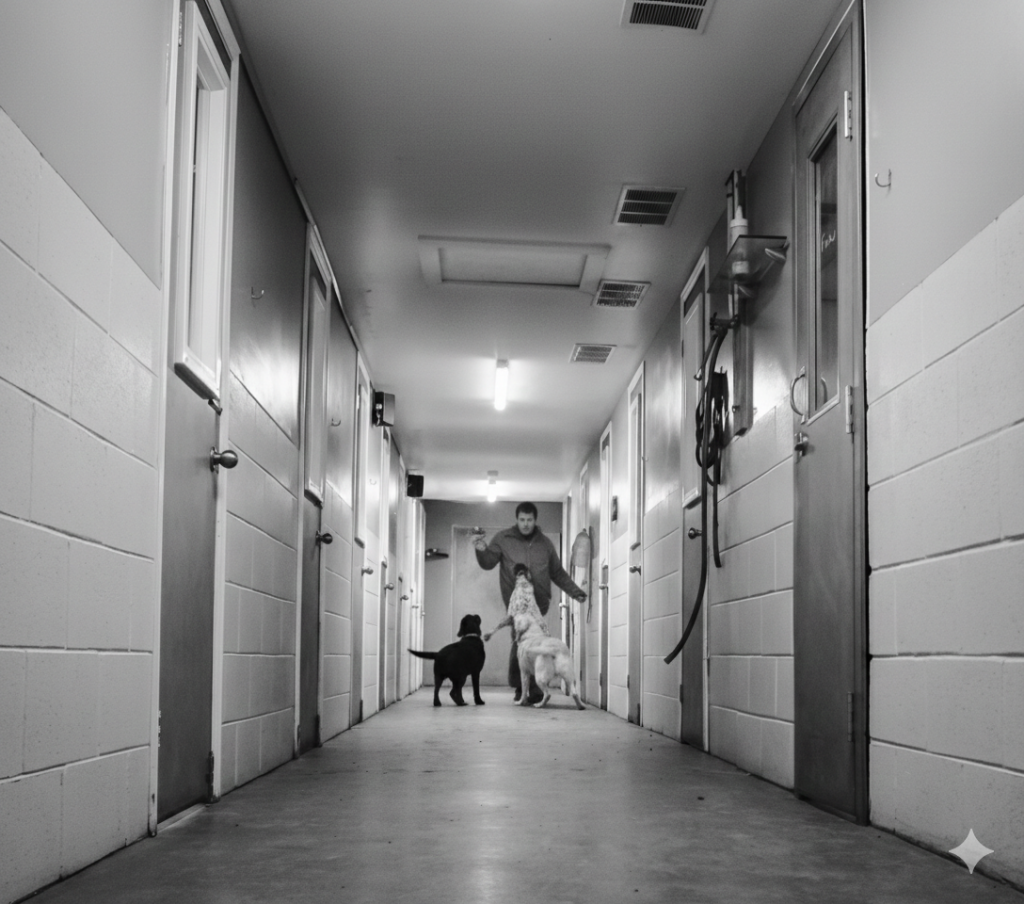
This is what a well-designed kennel looks like from the inside.
Credential Hubris
The vet tech assumption
Someone might point to being a vet tech or having formal animal-care training as proof that they understand what it takes to run a kennel. That training is valuable — it gives a real leg up in handling dogs, spotting health issues, and navigating welfare considerations. But a one- to three-year credential does not map onto the full operational complexity of running a multi-dog boarding facility day in and day out for years on end.
The business degree assumption
The flip side is equally true. Knowing how to build spreadsheets, model cash flow, or write a business plan doesn’t prepare you for the lived realities of animal behaviour, stress management, and the moment-to-moment decision-making required on the floor. Expertise doesn’t transfer cleanly across domains just because both domains are part of the same business.
What kennels actually require
Kennels are layered systems. There’s dog handling, yes. There’s also facility design, noise management, arousal regulation, staffing systems, scheduling, client communication, regulatory compliance, cash flow management, marketing, accounting, and the psychological toll of operating in a high-stress environment. In the early stages, you don’t just run one part of the system — you temporarily are the system. Viability improves when ambition is paired with humility about what you can actually carry alone.
What Viability Testing Actually Looks Like
The question most plans don't ask
Most business plans are written as best-case narratives. Demand is assumed to materialize. Costs are assumed to behave. Timelines are assumed to be mostly linear. Viability testing asks a different question: “What does this look like when several things go wrong at the same time?” What happens when demand comes in at half of what you projected? When build costs run over? When timelines double?
What buffers actually are
Viability testing isn’t pessimism. It’s respect for compounding risk. A viable operation has buffers: financial buffers, time buffers, staffing buffers, and emotional buffers. It has policies that hold under pressure. It has infrastructure that tolerates abuse.
Buffers aren’t just financial. Time and human bandwidth are buffers too — and they’re the ones founders tend to underestimate most. Building a business while also building a life compresses margin everywhere: attention, recovery, and decision quality.
The living document
Viability testing is an ongoing posture, not a one-time exercise. The terrain changes. Markets change. Regulations change. Your own capacity changes. A plan has to be reactive and proactive at the same time — reactive enough to withstand the dangers that inevitably show up, and proactive enough to take advantage of opportunities when they appear. That tension is where viability actually lives.
Where to Go Next
Maps are meant to change how you see the terrain,
not replace the work of walking it.
If this raised more questions than it answered, the next step is learning how to work through them properly.